Eager Beaver
The Door into SummerEager Beaver is a hospital service automaton whose ordinary work—setting out breakfast and responding to spoken commands—becomes a startling encounter with Dan Davis’s own engineering past. Its polished design and patent record lead Dan from the suspicion that his work had been stolen to the revelation that he himself was named as the inventor, making the machine both a practical appliance and a material link between his earlier life and the future he has entered.
Appearance and Operation
At the hospital, Eager Beaver rolls in to serve Dan breakfast, adjusts the built-in bed table, swings it into place, and arranges the meal. When Dan asks it to pour his coffee, the request prompts the automaton to produce an instruction sheet rather than simply carry on. The sheet identifies it as the Eager Beaver Model XVJI-a and explains that it does not understand human speech: it is a machine designed to respond to a limited list of spoken orders. It ignores other speech, but when a phrase triggers an incomplete response or creates a circuit dilemma, it offers the instructions.
The printed list includes basic commands such as stop, go, yes, no, slower, faster, come here, and fetch a nurse, as well as hospital routines such as back rubs. Many of the routines are not explained to ordinary users: the sheet says that routines 87 through 242 can be ordered only by hospital staff and therefore omits their command phrases. Eager Beaver’s apparent conversation is thus a carefully bounded interface. It can act on designated verbal cues without understanding what people mean, a distinction made explicit by the notice attached to the machine.
From Flexible Frank to Eager Beaver
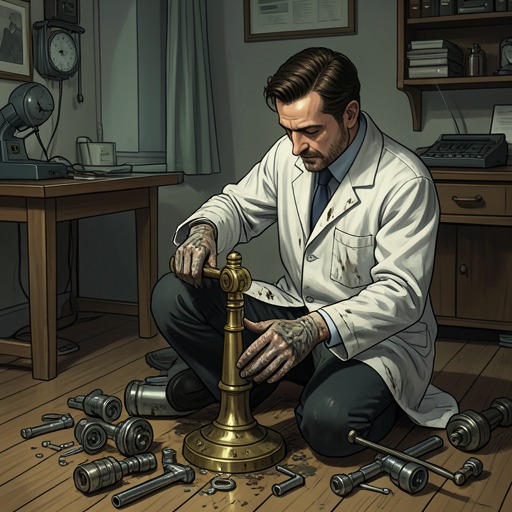
Dan recognizes the automaton as the descendant of Flexible Frank, the device whose basic pattern he had designed before being displaced from his company. This is not the crude first model, but a greatly improved machine: Dan compares the difference to that between a modern turbospeedster and the first horseless carriages, while recognizing the underlying family resemblance. He sees in Eager Beaver the evolution of his own work—more efficient and more capable, but still part of the same lineage.
The contrast also clarifies what has changed technically. Dan had not voice-coded the first Flexible Frank; its controls were buttons on a board. He had considered speech analysis and a telephone exchange, but at the time those components would have outweighed, enlarged, and cost more than the rest of the machine. Eager Beaver’s compact voice-command system therefore confronts him with advances in miniaturization and simplification that his earlier design could not yet support. Rather than treating the difference as proof that engineering belongs to one isolated inventor, Dan reflects that practical invention depends on the broader state of technology: a good idea cannot be built effectively before the necessary supporting advances exist.
Patents and the Inventor’s Identity
The automaton’s data plate gives Dan more than its model and serial information. It lists roughly forty patents, with the earliest dated 1970. Dan writes down the number, initially treating the discovery as an intellectual question. He suspects the patent may have derived from his original model and drawings, but also considers whether Eager Beaver could have been an independent parallel invention. Its name and the company that made it initially leave open the possibility that the machine’s commercial history is not the same as Flexible Frank’s.
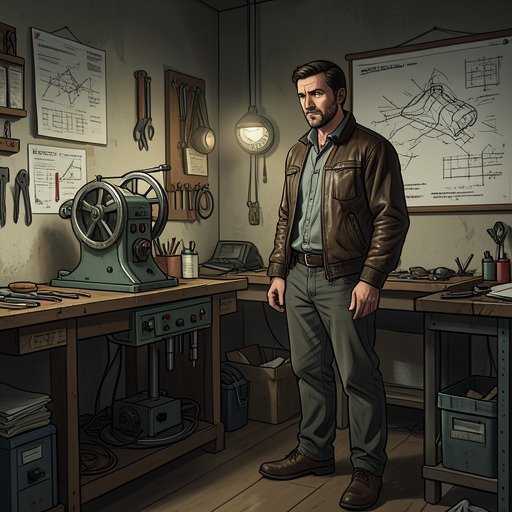
Dan later pursues the matter through the patent records. After learning that records of expired patents are held at the National Archives in Carlsbad Caverns, he pays for copies of the descriptions, claims, drawings, and histories of the patents for Eager Beaver and Drafting Dan. He compares the Eager Beaver drawings with Flexible Frank and admits that the design is not simply the same machine: it is better, capable of doing more, and has some simpler linkages. Yet its basic principles are related, as a machine controlled by Thorsen tubes and ancestral to Eager Beaver would be expected to be.
The decisive answer lies on the patent documents. Dan recognizes the inventor’s name as D. B. Davis. The discovery overturns the account he had been given by Belle: rather than having his model stolen and passed to an unknown engineer, his work had apparently been handed to another engineer for refinement, and the patent application had been made in Dan’s name. That revelation does not resolve every part of the company’s history—Dan is certain the Mannix deal never went through, despite Belle’s explanation that failure to produce Flexible Frank had soured it—but it establishes that Eager Beaver’s ancestry is not merely an echo of his work. The patent identifies Dan as its inventor.
Commercial Legacy and Later Use
The instruction sheet associates Eager Beaver with Aladdin Autoengineering Corporation, whose product list also includes Will! Wa W, Drafting Dan, Builder Bill, Green Thumb, and Nanny. Its trade mark shows Aladdin rubbing a lamp as a genie appears, and the slogan is “At Your Service!” This branded product family places Eager Beaver within a developed automation business, far removed in scale and finish from the early prototype Dan remembers.
Eager Beaver remains useful in Dan’s later life as well as significant to his investigation. After marrying Ricky, Dan takes her to a guest ranch near Tucson, where they stay in a cabin away from the main lodge and have their own Eager Beaver to fetch and carry, allowing them to avoid seeing anyone. The machine’s domestic service recalls the practical promise behind Dan’s early work, now realized in a mature commercial form. Its place in the final arrangement is quietly consequential: the automaton that first made the future legible to Dan becomes part of the private life he builds with Ricky.